Back in April, a Yale undergraduate was killed in a physics workshop when her hair was caught in a lathe and strangled her. I go on and on about lab safety on this blog, in my lab, and in talks and lectures because the consequences of negligence are very real. The Paleo Portal Health and Safety webpage was developed in part from the safety section of our lab manual, and incorporated many other lab's practices. Her accident could have been avoided by following at least three of our safety rules at VPL. First, no one but myself and our museum exhibits designer are allowed to use large power tools, including but not limited to: the bench grinder, drill press, electric miter saw, metal chop saw, Skil circular saw, and welding equipment. This by itself would have almost completely eliminated the risk of a student being hurt. Second, and obviously, all long hair, jewelry, loose clothing, etc, is required to be securely bound and out of risk for being caught in tools. Third, no one is allowed to work with any of these tools alone.
The major limiting factor in the effectiveness of these policies is enforcement. When physical access to the area can not be prevented for what ever practical reasons, tools can and should be disabled through lock out systems to guarantee that only authorized personnel can activate them. I'm very disappointed with the reaction of some members of the educational community interviewed from other institutions in the Wall Street Journal article linked above. Particularly the voices from one of my former employers, the University of Chicago. According to the WSJ article, physics professor Stephan Meyer "echoed concerns over eliminating one of the most fruitful work periods for undergraduates. 'I don't do anything during the day because I'm talking to people,' he said. 'Work happens at night and that's when research happens." Another UChicago faculty member agrees, again from the article-
"One really worries that a story like this gets the press all over it and all of a sudden undergraduates can't use the shop in the evening hours which is the only time they can really devote to the work because they're busy with courses during the day," said University of Chicago physics professor Mark Oreglia. Unfettered access to lab equipment "is something that the undergraduates really benefit from," he said. He recalled spending long hours at the machines as a student, toiling by himself on projects into the night."
My response to him? Too fucking bad. When he is in the role of explaining to a dead students parents, university lawyers, and the media why his laboratory policy was not one of "Safety First", his opinion might be changed. Working late at night, while exhausted, and under pressure is THE TIME when someone is most likely to make mistakes and cut corners. Add youth into the equation and the students are probably safer drinking and driving at 2:30am on a weekend. To defend such practices is irresponsible (I'd say grossly negligent), idiotic, and devoid of an understanding of how the real world works. This is a fundamental problem in academic culture, the real heart of the issue, safety accountability in research labs. This Nature News article discuss this in detail, and I suggest should be required reading as part of any lab orientation.
Tuesday, June 14, 2011

Monday, June 13, 2011
Other people do this...
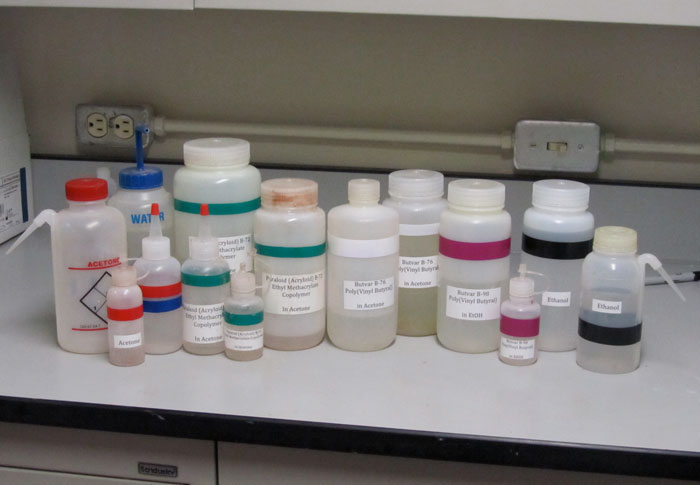
I just finally got around to finishing the process not too many months ago. Labeling secondary containers thoroughly, that is. I've talked about properly labeling and storing chemicals here, here, and here, and while I don't think this will be my last post about this topic that I take pretty damn seriously, I might have said enough to last us all awhile. Unless of course, you still aren't storing and labeling your chemicals properly, then I need to keep bitching. Tomorrow's post will be about why this topic makes me so bitchy. At any rate, here we are, with today's topic, the big reveal!!! In addition to the color-coding system that I've expanded from the Sanders lab at Michigan, I've added a printed label to clearly explain what the material is, adopted from at least the Yale Peabody Museum and probably others. Why this redundancy? Well, Marilyn Fox left a bottle of Paraloid B-72 in my truck in the Chinle last year because she didn't want to take it on a plane, wisely, and looking at its neatly typed informative label had been making me feel guilty all year (yes, that means it has been in my cup holder in the center console since this time last year.) But you want the real recap? So, color-coding creates instant recognition that these are all distinct materials, just because they are all clear liquids they should not be assumed to have the same properties or chemical structures. Secondly, this system makes it easier for new folks in the lab to remember what kind of materials they were using, kinda like flash cards. Third, the electrical tape used for labeling is very resistant to mild spills of solvent, unlike the Sharpie marker that all the bottles were initially marked with. For a period of time (until I got to it), the colored tape was used as a back-up to the Sharpie. Since handwriting is so inconsistent, and the marker was so frequently and inevitably smeared and not rewritten, and also usually incompletely labeled, I switched over to printed labels completely covered over with packing tape, a procedure which is also resistant to normal amounts of solvent spill. The label also provides a safety option for any colorblind lab workers. After all of this, I think it is highly unlikely that Environmental Health and Safety will have a problem with our storage and labeling. I'm just glad they never found last week's coffee can of kerosene.
 |
| Yes, yes, I know. This image is shit for resolution, but you get the idea. |
Sunday, June 12, 2011
Ultimate field vehicle...
Found it! Now I just need to find a million dollars...
 Introducing the Unicat Luxury Expedition line of vehicles. I'm just gonna say holy shit!, and let you check out the interiors for yourselves. I'm in love.....

Saturday, June 11, 2011
Field trailers

 pack with room to spare. Before I get too carried away here, I think backcountry gear breakdowns will be a different post. I'm really quite content with bare bones camping, and have always remained very comfortable in the process. These days, if I'm near my vehicle, I just push some crap off to one side and throw my sleeping bag in the back of my truck, or when that is full, sleep upright in the drivers seat. After 11 years of field work and 25 years of camping, 2010 marked the first time I had slept on a Thermarest, or any ground pad, for that matter. I must say, I do like it, but what I'm getting at with all of this is that I have a hard time justifying a need for a camper trailer for any sort of camping, let alone field work. But I want to try, because I like to build stuff, I thrive on projects, and I want to find a way to put an LCD monitor and microscope, air compressor, and dust collector in it. I may have to take out the head and replace it with a trenching tool with a roll of TP jammed onto it. I would be very interested to hear opinions from anyone with experience with such thing (trailers at remote field locations, not toilet paper and shovels.)
[Edit 6/12: Just thought this was a nice video]
Friday, June 10, 2011
Hazardous waste disposal
 |
| Shocked to find kerosene stored in a coffee can. |
In keeping with UT and lab policy for Hazardous Chemical Waste disposal, I decanted the compatible fuels into a 20L Nalgene carboy that was tagged with an EHS Waste Disposal label with my name, UTID number, lab contact, building and room number, and full chemical description. You'll notice from the photos that this was done wearing PPE and working in the vent hood. All of the gas was discolored, varying from straw, to red, to brown, and had probably been bad for 10 years or more. The kerosene coffee can had begun to rust through and was leaking a bit. After draining the containers, they were left in the fume hood to vent for a while, and then closed up and replaced in the flammable cabinet. The next step in the process is filling out the Request for Chemical Disposal and faxing it over to EHS and scheduling a day for pick up. It has taken an interminably long time to get through all of this material, I've made several attempts at it over the last two years, and have sent off about 350 containers of expired, redundant, or dangerous materials for proper disposal (no, we don't pour it down the sink!) This last pickup should be the last for quite some time.
 |
| I'm melting... I'm melting. What a world, what a world... |
 |
| Freeing these bottles and buckets from the bottom of the box was a bugger |
Thursday, June 9, 2011
4th FPCS Proceedings PDF available
(I've successfully made two days of posts in a row! This is a promising start!)
Many thanks to Arvid Aase at Fossil Butte National Monument for both hosting the wildly successful 2011 Fossil Preparation and Collections and editing, along with Tyra Olstad, the Proceedings, which are now available for free download! This handy reference includes all of the abstracts from the meeting, a couple of extended abstracts, and four papers on paleo methods. Thanks again to Tyra, Arvid, and everyone who contributed!
PROCEEDINGS OF THE 4th FOSSIL PREPARATION & COLLECTIONS SYMPOSIUM, APRIL 2011
BRIGHAM YOUNG UNIVERSITY
GEOLOGY STUDIES
Volume 49(B), 2011
ABSTRACTS for WORKSHOPS and ORAL PRESENTATIONS
* also an article
* Now what did the paleontologist find? Adjustable exhibits for a changing world.
Arvid K. Aase........................................................................................................................................ 1
An infinitely-adjustable work stage for precision preparation of microfossils under high magnification.
Gregory W. Brown............................................................................................................................... 1
Exercising judgment in the paleontology laboratory.
Matthew A. Brown............................................................................................................................... 2
* Vacuum molding and casting for bubble free fossil replicas.
Jennifer L. Cavin................................................................................................................................... 2
* Acid preparation of the gill skeleton of fossil fishes.
Robert L. Evander................................................................................................................................ 3
* Continued Improvements in the use of archival materials for the padded plaster jacket.
William Keyser, Peter Kroehler, and Steven Jabo............................................................................. 3
Testing the effectiveness of two commonly used consolidants in palaeontological preparation.
Jim McCababe and Rhian Russel............................................................................................................. 6
Cost effective assembly and operation of equipment to make excellent casts.
Peter Reser........................................................................................................................................... 6
Putting a fine point on it...advanced pin vise preparation techniques: materials and methods.
Connie Van Beek............................................................................................................................. 7–10
POSTER PRESENTATIONS
Soft tissue preparation in mosasaurs from the Smoky Hill Chalk.
Anthony E. Maltese......................................................................................................................... 4–5
Cut and punch: Use of a center-punch to isolate and remove small specimens from hard sediments.
William R. Wahl................................................................................................................................ 11
ARTICLES
Now what did the paleontologist find? Adjustable exhibits for a changing world.
Arvid K. Aase.......................................................................................................................................12
Vacuum molding and casting for bubble free fossil replicas.
Jennifer L. Cavin..................................................................................................................................24
Acid preparation of the gill skeleton of fossil fishes.
Robert L. Evander...............................................................................................................................29
Continued improvements in the use of archival materials for the padded plaster jacket.
William Keyser, Peter Kroehler, and Steven Jabo............................................................................33
Many thanks to Arvid Aase at Fossil Butte National Monument for both hosting the wildly successful 2011 Fossil Preparation and Collections and editing, along with Tyra Olstad, the Proceedings, which are now available for free download! This handy reference includes all of the abstracts from the meeting, a couple of extended abstracts, and four papers on paleo methods. Thanks again to Tyra, Arvid, and everyone who contributed!
PROCEEDINGS OF THE 4th FOSSIL PREPARATION & COLLECTIONS SYMPOSIUM, APRIL 2011
BRIGHAM YOUNG UNIVERSITY
GEOLOGY STUDIES
Volume 49(B), 2011
ABSTRACTS for WORKSHOPS and ORAL PRESENTATIONS
* also an article
* Now what did the paleontologist find? Adjustable exhibits for a changing world.
Arvid K. Aase........................................................................................................................................ 1
An infinitely-adjustable work stage for precision preparation of microfossils under high magnification.
Gregory W. Brown............................................................................................................................... 1
Exercising judgment in the paleontology laboratory.
Matthew A. Brown............................................................................................................................... 2
* Vacuum molding and casting for bubble free fossil replicas.
Jennifer L. Cavin................................................................................................................................... 2
* Acid preparation of the gill skeleton of fossil fishes.
Robert L. Evander................................................................................................................................ 3
* Continued Improvements in the use of archival materials for the padded plaster jacket.
William Keyser, Peter Kroehler, and Steven Jabo............................................................................. 3
Testing the effectiveness of two commonly used consolidants in palaeontological preparation.
Jim McCababe and Rhian Russel............................................................................................................. 6
Cost effective assembly and operation of equipment to make excellent casts.
Peter Reser........................................................................................................................................... 6
Putting a fine point on it...advanced pin vise preparation techniques: materials and methods.
Connie Van Beek............................................................................................................................. 7–10
POSTER PRESENTATIONS
Soft tissue preparation in mosasaurs from the Smoky Hill Chalk.
Anthony E. Maltese......................................................................................................................... 4–5
Cut and punch: Use of a center-punch to isolate and remove small specimens from hard sediments.
William R. Wahl................................................................................................................................ 11
ARTICLES
Now what did the paleontologist find? Adjustable exhibits for a changing world.
Arvid K. Aase.......................................................................................................................................12
Vacuum molding and casting for bubble free fossil replicas.
Jennifer L. Cavin..................................................................................................................................24
Acid preparation of the gill skeleton of fossil fishes.
Robert L. Evander...............................................................................................................................29
Continued improvements in the use of archival materials for the padded plaster jacket.
William Keyser, Peter Kroehler, and Steven Jabo............................................................................33
Wednesday, June 8, 2011
I'm coming back, plus Jack Horner
All right, after a more or less sixth month absence I've finally succumbed to the pressure to reinvigorate this blog. The very last thing I've got time for. I just turned 30 last week, so I'm renewing some resolutions, eating better, working out more regularly, trying to get at least 6 hours of sleep a night, maintaining an abandoned web log... In order to make sure this happens, I'm going to promise to commit to at least 7 solid days of blog posts. This first one is a softball, as I'm coasting on the name recognition of both Horner and the fabulous TED Talks series.... however, this was brought to my attention by one of my rare, non-paleo friends, for the first time she brought a paleo news item to my attention that I hadn't already known about 10 years earlier!
I include this because it is an interesting talk, but also because of the MOBILE Molecular Paleontology Field Station at 8:44!!! How has this awesome thing escaped my radar?
I include this because it is an interesting talk, but also because of the MOBILE Molecular Paleontology Field Station at 8:44!!! How has this awesome thing escaped my radar?
Subscribe to:
Posts (Atom)


